Updated 15-September-2026
GCSEs in England have been graded 9 to 1 since 2017, with 9 the highest. Grades 9, 8 and 7 replaced A* and A; grades 6, 5 and 4 replaced B and C; grades 3, 2 and 1 replaced D, E, F and G. Grade 4 is a standard pass and grade 5 is a strong pass.
One caveat before you use that table, and it matters: the new and old scales do not convert exactly. Nine numbers were mapped onto eight letters, so only three points genuinely line up. The rest of this page explains which three, what each grade actually means, and what to do if you did not get the grade you needed.
The reformed GCSEs were introduced from 2017 in England, starting with English language, English literature and maths, and rolling out across other subjects over the following two years.
The point of the change was not to relabel the same thing. The old A*–G scale had become crowded at the top — a large group of students sat in A and A*, and universities and employers struggled to distinguish between them. The new scale adds a grade above the old A*, giving more separation at the high end, and it signals clearly that the qualification content changed too.
Using numbers rather than letters was deliberate: it makes it obvious at a glance whether a result comes from the old or the new specification.
Ofqual's own summary is the clearest:
"Grades A* and A are now replaced by grades 9, 8 and 7. Grades B and C are replaced by grades 4, 5 and 6. Grades D, E, F and G are replaced by grades 1, 2 and 3."
Notice the shape of that. Three new grades cover what used to be two, at both the top and the bottom. That is why a clean one-to-one table is impossible — and why the tidy conversion charts you will find elsewhere are, strictly speaking, wrong.
There are exactly three places where the old and new scales are designed to align. Ofqual and the Department for Education both state them the same way:
Everything between those points is a matter of distribution rather than direct translation. So "grade 6 equals a B" is a useful approximation for conversation, but if you need precision — for an application, a job specification, or an entry requirement — the three anchors are the only statements with official backing.
The practical version, from GOV.UK: "if an employer used to set entry requirements of at least a grade C, the equivalent is to require at least grade 4."
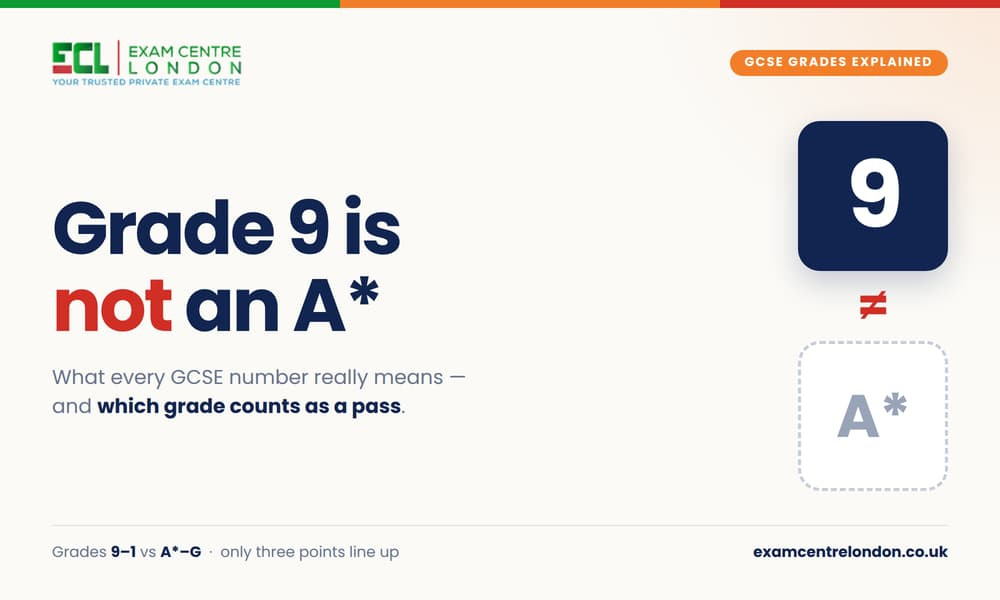
The highest grade available, and not simply a renamed A*. Grade 9 was designed to be harder to achieve than the old A*, identifying the very strongest performers.
It is awarded by formula. Ofqual's "tailored approach" sets it as:
Percentage of those achieving at least a grade 7 who will be awarded a grade 9 = 7% + 0.5 × (percentage of students awarded grade 7 and above)
The effect is that roughly 20% of students who achieve grade 7 or above go on to get a grade 9 — a smaller group than used to receive A*. If your child has a 9, it is a genuinely exceptional result, and comparing it to an A* understates it.
Sits between 7 and 9, and is positioned mathematically midway between them on the mark scale. In old terms it straddles the A*/A boundary — a strong A* under the previous system.
Roughly equivalent to the old grade A, and one of the three official anchor points: the bottom of grade 7 lines up with the bottom of the old A. Grade 7 is the usual minimum for taking a subject at A-Level, and many sixth forms ask for 7s in the subjects you intend to continue.
Roughly equivalent to the old grade B. A solid result, above a standard pass and above a strong pass, and enough for most sixth form and college entry requirements — though not always for the specific subject you want to study at A-Level.
Officially a "strong pass". AQA describes it as equivalent to a high C and low B on the old scale. This is the grade the Department for England uses as the higher benchmark in school performance measures, and some colleges and employers ask for a 5 rather than a 4 in English and maths.
A "standard pass", and the grade that matters most in practice. It is the official equivalent of the old grade C, it is the threshold that satisfies most entry requirements, and — importantly — students in England who do not achieve at least a grade 4 in English or maths are normally required to keep studying those subjects post-16.
If a course, employer or apprenticeship asks for "GCSE English and maths", a grade 4 is almost always what they mean.
Roughly the old D, and a little of the E. Below a standard pass, so it will not meet a "grade 4 or above" requirement — but it is far from a fail, and it is close enough to a 4 that a resit is often very achievable.
Equivalent to the old E, F and G. Grade 1 is the lowest awarded grade, and its bottom aligns with the bottom of the old grade G — the third anchor point.
Ungraded. The performance did not reach the standard for a grade 1, and no grade is recorded for that subject.
This is the most-asked question about GCSE grades, and the confusion is the government's own doing — the benchmark was set at grade 5, then revised down, leaving two "passes" in circulation.
The current position:
Grade 4 — standard pass. The equivalent of the old grade C, and the level most entry requirements mean.
Grade 5 — strong pass. Used in school performance measures and asked for by some selective colleges and employers.
Neither is a "fail" in the old sense; grades 1 to 3 are still awarded grades. But for practical purposes — sixth form, college, apprenticeships, most jobs, and the post-16 English and maths requirement — grade 4 is the line that matters.
Always check the specific requirement rather than assuming. Requirements vary more between institutions than most people expect, particularly for nursing, teaching and medicine.
A missed grade 4 in English or maths is the single most common reason people come to us, and it is a fixable problem — but the routes have deadlines, so it is worth knowing them now rather than in the spring.
Resit in November. GCSE English language and maths run a November series each year, so you do not have to wait for the summer. Entries close in early October, which is sooner than most people realise.
Resit in the summer. All subjects are available in the May–June series. Entries close in late February.
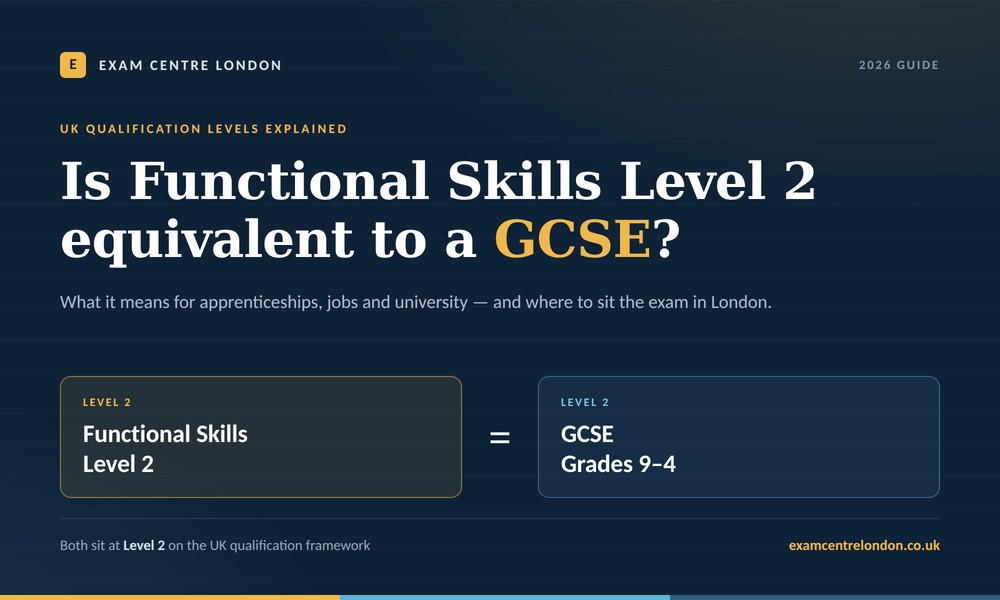
Take Functional Skills Level 2 instead. It sits at the same level as a GCSE grade 4 on the official qualification framework and is accepted in place of one for most apprenticeships and many jobs — though some universities and professions ask for the GCSE specifically. It is assessed on demand rather than in fixed exam windows, which makes it much faster if you are on a deadline.
Ask for a review of marking. If a grade looks wrong, post-results services have their own deadlines shortly after results day. For a private candidate, the request goes through the centre that entered you.
You do not need to be at a school to do any of this. As a private exam centre, we enter candidates for GCSE and IGCSE regardless of where — or whether — they studied.
Check entry deadlines — November closes in early October
Read our guide to November GCSE resits in London
Contact us — 0208 616 2526, info@examcentrelondon.co.uk
Worth separating, because the two get confused constantly.
Grades are what this page is about: what the number means, permanently.
Grade boundaries are how many marks you needed for each grade in a particular paper, in a particular year, with a particular board. They move every year, because papers vary in difficulty and boards adjust so that a grade means the same thing regardless of which year's paper you happened to sit.
If you are looking for the marks rather than the meaning, see our guide to Edexcel grade boundaries.
The 9–1 scale applies to GCSEs taken in England. GCSEs awarded in Wales and Northern Ireland continue to use A*–G letter grades, so a student moving between systems may hold both.
International GCSEs vary by board — some are graded 9–1 and some A*–G. Check with your exam board or centre if you are unsure which scale your certificate uses. See our guide to IGCSE vs GCSE for the wider differences.
What are GCSE grades 1-9 equivalent to?
Grades 9, 8 and 7 replaced A* and A; grades 6, 5 and 4 replaced B and C; grades 3, 2 and 1 replaced D, E, F and G. Only three points align exactly: the bottom of grade 7 with the bottom of old grade A, the bottom of grade 4 with old grade C, and the bottom of grade 1 with old grade G.
What is grade 4 equivalent to?
A grade 4 is the equivalent of the old grade C and is officially a "standard pass".
What is grade 5 equivalent to?
Grade 5 is a "strong pass", described by AQA as equivalent to a high C and low B on the old scale.
What is grade 6 equivalent to?
Roughly the old grade B.
What is grade 7 equivalent to?
The old grade A. The bottom of grade 7 is an official anchor point aligned with the bottom of old grade A.
Is grade 9 the same as an A*?
No. Grade 9 is above the old A*. It is awarded by a formula that gives it to about 20% of students who achieve grade 7 or above — fewer than used to receive A*.
What is a pass in GCSE? Grade 4 is a standard pass and grade 5 a strong pass. Most entry requirements mean grade 4.
Is a grade 3 a fail?
No — grade 3 is an awarded grade, roughly the old D. It does not meet a "grade 4 or above" requirement, but students at grade 3 are usually well placed to reach a 4 on a resit.
When did GCSE grades change to numbers?
From 2017 in England, beginning with English language, English literature and maths, and extending to other subjects over the next two years.
Can I resit to improve my grade?
Yes. English language and maths run in November as well as the summer; all other subjects run in the summer series. Private candidates can enter through an exam centre without being enrolled at a school.
Recent Posts
Categories
Tags